Thursday, February 27, 2014

An Introduction to Adolescent Health Issues

INTRODUCTION TO HEALTH ISSUES IN PERU

Peru has been recognized for making strides to curb maternal and infant mortality, and increase life expectancy.  Peru’s economy has been growing at an impressive rate and generous funds have been allocated to improve health care delivery and organize interventions to address urgent issues at a local level.  Peru’s national Ministry of Health recognizes its critical role in increasing access to health care services and addressing the health issues plaguing children which prevent them from becoming productive adults.

The Ministry of Health has outlined a plan of action to address a range of health issues across several target populations, and has partnered with Peace Corps Peru to carry out critical interventions to ensure adequate development of children under three years of age and adolescents aged 12-17.  Adolescents are generally lacking in reproductive health education and access to resources for the prevention of unintented pregnancy, HIV and sexually transmitted infections.  The teen pregnancy rate nationally hovers around 13% (for girls aged 15-19) but is slowly creeping upwards.  Locally, in the Piura region, statistics from 2012 show the rate has risen above 16%, a dramatic increase from 9% in 2000.

 COMMUNITY DIAGNOSTIC

The district of El Tallán is comprised of four neighborhoods, with about 2,500 residents (not including the annexes).  The main neighborhood of Sinchao Grande hosts the municipal building, the health center and the only high school serving the district.  Among the 2,000 residents of the community of Sinchao Grande, just over 600 are adolescents.  Students attend high school for five years and graduate high school around age 16.

To determine the most pressing social issues impacting adolescents in the community of Sinchao Grande, I interviewed two community leaders who operate a church-affiliated youth group for teens, plus several parents and teachers.  In addition, I surveyed a group of high school students on their knowledge of pregnancy prevention and transmission of HIV and sexually transmitted infections (STIs).  Lastly, I conducted a SWOT analysis to record perceptions of the resources available to youth in the community.

According to statistics provided by the Ministry of Health RED Bajo Piura, 21 teenagers visited the El Tallan health center in 2012.  One-third of these patients (7) sought attention for an existing pregnancy, and six received services to treat a sexually transmitted infection. Only three teenagers sought family planning services last year at the health center.

The statistics show that among the 612 adolescents between the ages of 12 and 17 living in the district of El Tallán, the prevalence of sexually-transmitted infections (STIs, including HIV) and teen pregnancy rates are remarkably low.  STI rates are at 0.98 % and the pregnancy rate for teens is at 1.14%.  If the data correctly reflect the true incidence of adolescent pregnancies in the district, the rate for the district is 14 times lower than for the region as a whole, which is unlikely given the lack of adequate pregnancy prevention and STI-focused public health interventions in the district.

We should bear in mind that these statistics represent the number of cases reported to the local health facility.  There is a good possibility that more cases of teen pregnancy and sexually transmitted infections existed among adolescents in El Tallan in 2012 which were not reported to authorities.  An unfortunate aspect of the health facility is its visibility and the lack of privacy afforded to patients seeking services, which was reported to me by community members and noted through casual observation.  Even if a woman or girl sought reproductive health services under the guise of a different (less controversial) issue, there would be no assurance to her that the health workers would maintain her confidentiality, given the existence of a legal obligation to obtain consent from her parents.

Adolescents who participated in the Community Diagnostic survey indicated no current or past sexual activity, even though one of the participants admitted to being in a dating relationship.  Less than half of the participants indicated having received instruction on sexual and reproductive health.  Among those who had received instruction in school, several mentioned that they felt that the instruction was insufficient.  Only one had received instruction on a sexual health topic at the health facility.

Key points from the Community Diagnosis and SWOT Analysis:
• 30% of adolescents could not name one method to prevent unwanted pregnancy and sexually transmitted infections.
• Only one person was able to describe the steps to use a condom correctly.
• Less than half of the participants could name at least one method of preventing transmission of HIV.
• Adolescents mentioned a lack of opportunities to develop leadership skills and job skills.
• Adolescents expressed the desire to improve communication with parents.

With respect to adolescents, there is clearly a lack of understanding of the methods to protect against unwanted pregnancy and sexually transmitted infections. Given the reportedly low teen pregnancy rate, it will be important to reinforce healthy behaviors among this generation of young adults who are serving (willingly or not) as role models to influence the next generation of youth.

Furthermore, the lack of opportunities to acquire leadership skills and job training may leave youth unprepared for the demands of a career, or full contribution to the community. These opportunities can give legitimacy to the decisions that teens make with respect to the delay of initiation of sexual activity, as placing a value on activities that expand the possibilities for the future can reduce the desire to engage in risky activities that could derail future plans.

The ideal program will incorporate life planning as one component in a comprehensive reproductive and sexual health curriculum with a peer education component.  Please continue reading to find out how we addressed these issues by utilizing best practices in Peru and adapting them for the particular needs of the community.

Please continue reading about the Pasos Adelante project to improve the health of adolescents.

Thursday, February 20, 2014

PASOS ADELANTE - A Project for Adolescent Reproductive and Sexual Health

Pasos Adelante (or Steps Forward in English) is a program that was developed by Peace Corps Peru in coordination with Peru’s national Ministry of Health to help youth develop essential life skills to avoid unwanted pregnancies and make healthy life decisions.


The program consists of fourteen lessons on a variety of topics:
1.       SELF-ESTEEM and SELF-CONFIDENCE
2.       POSITIVE VALUES
3.       MANAGING STRESS
4.       ALCOHOL AND DRUGS
5.       DECISION-MAKING
6.       DOMESTIC VIOLENCE
7.       PLANNING FOR MY FUTURE
8.       ADOLESCENCE AND SEXUALITY
9.       GENDER AND SEXUALITY
10.   STIs (Sexually Transmitted Infections)
11.   HIV & AIDS
12.   PREGNANCY
13.   ABSTINENCE & SEEKING AN IDEAL PARTNER
14.   CONDOMS AND MODERN BIRTH CONTROL METHODS

The program is intended to reduce the number of sexually transmitted infections, prevent early pregnancy, prepare adolescents to make responsible decisions about their sexuality, and give them the tools to become leaders in their communities.

The Pasos Adelante program can be adapted to provide opportunities for students to train other students in the aforementioned topics as peer educators.  Research shows that youth more readily trust and retain the information provided by other youth more than information provided by adults.  Multiple research studies have concluded that peer education program are more effective in improving knowledge among adolescents and is recommended as a strategy to reduce the prevalence of pregnancy and STIs among youth.

The Pasos Adelante program was designed with the concept that skills and learned behaviors between peers can be very effective in promoting healthy decision-making among young people.  Expected outcomes of the program are that:
• Fewer young people will become infected with an STI, HIV, or AIDS, and fewer young people will become pregnant during adolescence;
• Young people will take safe and responsible decisions about the best time to start having sex and how best to protect them when they have them; and 
• Young people will develop tools and characteristics to become leaders in their communities, including high self-esteem, assertive communication and healthy decision-making skills.

THE PLAN

My interactions with youth during the diagnostic phase and afterward led me to believe that the high level of timidness around and ignorance of sexual health issues demonstrated by teens in the community may serve as a challenge to finding an adequate number of youth interested in becoming peer educators.  Initially, I utilized the resources and expertise of the health center staff to teach the Pasos Adelante lessons to high school students as a way to provide opportunities for youth to reach a comfort level with the material and to coach the health center staff in using non-formal teaching techniques.

I coached the health center staff, who prepared to teach six of the Pasos Adelante lessons to students in the 3rd and 4th year classes.  In the following school year, we planned to select ten of the best 4th and 5th year students to develop their leadership and presentation skills, who in turn, would replicate the Pasos Adelante lessons to a new group of 3rd and 4th year students.  This process could be repeated each year, and it allowed for students to participate in the lessons two years in a row, which contributed to memory retention and increased comfort level with the material.

During the 2013 school year, the health center staff taught six of the Pasos Adelante lessons to 40 students in 3rd year and 13 students in the 4th year classes in the following topics: Decision-Making, Seeking My Ideal Partner, Sexuality and Adolescence, Condoms and Modern Methods of Family Planning, Sexually Transmitted Infections, Alcohol and Drugs, and Planning for My Future.

We observed the interest and leadership skills of the students during the lessons, which allowed us to select the best students to serve as peer educators during the following school year, as these students entered the 4th and 5th year of high school.  During the 2014 school year, students were invited to apply to become peer educators and teach lessons to other students.

Among the 14 students who applied, five 4th year students and five 5th year students were selected to participate in a training event to develop their leadership abilities.  Eight students attended the training to become peer educators (four 4th year students and four 5th year students).  The training consisted of lessons in developing personal values, self-esteem, leadership skills, and managing stress presented by health center staff and by a recommended Psychologist.  Following the training, I worked closely with the students in one-on-one or small group sessions to develop their presentation skills and ability to use non-formal teaching techniques.

The four 4th year students were paired up and assigned a topic to teach alongside a health center staff member.  The responsibilities were divided such that the health center staff served as the experts on the topics and each presented factual information while the students directed the activities to practice the newly acquired knowledge and behaviors.  The 5th year students declined to participate further after attending the peer educator training due to school workloads and responsibilities at home.

The students were paired up and trained to use non-formal education techniques to present practice activities for experiential learning.  The presentation topics were Domestic Violence, Condoms and Modern Birth Control Methods, HIV & AIDS, and Abstinence & Seeking an Ideal Partner, which were presented to 53 students in the 3rd and 4th years of high school.

Parents School
In order to improve communication between parents and their children and reinforce the information presented in Pasos Adelante, we developed a Parents School event. It was intended to provide parents with positive communication techniques that would allow them to engage with their children about sensitive issues, such as sexuality and reproductive health, and planning for the future.

Parents School was focused on building trust and respect between parents and children.  After completing the course, parents were able to demonstrate a better knowledge and behaviors for use in supporting the healthy development of adolescents.

HIV Awareness
Once a teen decides to initiate sexual activity, it is essential that s/he has the knowledge and access to the use of contraception and protection against sexually transmitted infections and HIV. A key component in the effort to protect teens from unwanted pregnancy and infection is correct and consistent condom use.

The statistics of the health facility reflect that a very small number of adolescents have sought the services of family planning, probably because of the embarrassment and the risk of gossip.  In order to increase the likelihood that adolescents obtain and use condoms, we launched an HIV awareness event that included a condom demonstration.

The event was designed to normalize the use of condoms and remove at least some shame in obtaining condoms and initiating conversations with partners.  The event included information on the difference between HIV and AIDS, how infection occurs and testing methods, presented by a nurse technician and through educational videos provided by the Ministry of Health.  The demonstrations covered myths about HIV transmission, and challenged teams of students to describe the steps to use a condom correctly in an effort to win prizes.

Given that the Pasos Adelante program initially reached only 53 of the total 612 adolescents in four main villages in the district of El Tallán, we hoped this event could reach a wider audience and bring these messages of health and safety to more adolescents.  It was held after school hours to allow for participation among teens that attend other schools outside the district, or attend the local high school but are not enrolled in the 3rd and 4th year classes.

Please continue reading to discover the reality and the challenges of the project.

Thursday, February 6, 2014

PASOS ADELANTE - Reality and the Challenges

THE REALITY

During the 2013 school year we taught six of the Pasos Adelante lessons during the tutorial period (study hall) to 40 third-year and 13 fourth-year high school students once per week for 6 weeks. 

A special guest expert (personnel from the health center) was invited during each session to present on the topic of the week. 

DATE (2013)
TOPIC
AUDIENCE
PRESENTERS
October 29
Healthy Decision-making
Seeking My Ideal Partner
3RD year students 
4TH year students
Karen Crow, Peace Corps volunteer
Elena Iman, Nurse Technician
November 5
Adolescent Sexuality
3RD year students
4TH year students
Dr. Mayulli Rubio Ancajima
Karen Crow, Peace Corps volunteer
Elena Iman, Nurse Technician
November 12
Family Planning Methods
3RD year students
4TH year students
Cristina Gutierrez, Nurse Technician
Santos Albines, Nurse Technician
Elena Iman, Nurse Technician
November 19
Sexually Transmitted Infections
3RD year students
4TH year students
Norma Fiestas, Nurse Technician
Karen Crow, Peace Corps volunteer
Elena Iman, Nurse Technician
November 26
Drugs and Alcohol
3RD year students
4TH year students
Dagoberto Martinez Navarro, Nurse Technician
Karen Crow, Peace Corps volunteer
December 3
Planning for My Future
3RD year students
4TH year students
Elena Iman, Nurse Technician
Stefani Cano Vasquez, Lead Nurse


CHALLENGES IN 2013
1.       The lessons were taught during the once-weekly tutorial period, which were originally 50 minutes in length.  As the weeks passed, the teachers insisted on utilizing more and more of the tutorial period time to review material for upcoming exams.  Eventually, our time was reduced to 30 minutes per lesson.  

            a.       The lessons are intended to be carried out over a longer time period (1.5 hours) than we were allotted as part of the tutorial period (35-45 minutes).

            b.      Because of the shortened time, we were forced to cut out most of the activities that would have allowed students to practice and apply the newly learned material.

2.       The quantity of students in each lesson was not easily manageable.  There were 13 students in 4th grade and 41 students in 3rd grade, giving us 54 students in the combined class.  It was challenging to maintain their attention, keep them on task and limit the distractions and rowdiness.

3.       The Director of the school was suddenly relieved of his position in September of 2013, just as the school was returning from winter break.  After two months passed, the newly appointed temporary Director gave us permission to teach lessons, but the delay due to the circumstances cut short our teaching schedule.  We had only 6 weeks before the end of the school year, allowing us to teach only 6 once-weekly lessons.

4.       We worked as best we could within the confines of the educational system, knowing that taking the lessons outside of the high school walls would have severely reduced participation.  Most teens  are overburderned with responsibilities in the home and spend their afternoon hours studying, working on school projects, working on the family farm, taking care of farm animals, doing household chores, attending church services and/or participating in family activities.  It is rare for a teenager in my community to have free time, especially time to attend additional lessons outside of school.

5.       The copy machine in the Municipality often broke down and was left unrepaired for long periods of time, requiring me to utilize more grant funds for making copies than was originally intended.  Also, the workplan changed several times throughout the lifespan of the project, and a new Pasos Adelante manual was issued (the second edition), requiring additional unanticipated copy and printing needs.


RESULTS OF ACTIVITIES IN 2013

Results of the final survey administered after the end of the last educational session in 2013:

1.       Number of youth trained in sexual reproductive health and modern birth control methods in a small group setting, who can:
a.       identify at least 2 ways to prevent unwanted pregnancy and the transmission of sexually transmitted infections, and
b.      demonstrate the steps to correctly use a condom.

Males aged 10-14
7
Males aged 15-17
14
Females aged 10-14
11
Females aged 15-17
18
TOTAL
50

2.       Number of youth aged 15-24 who reported engaging in sexual activity in the past 3 months and who used a condom at last sex:
Males aged 15-17
1
Females aged 15-17
1
TOTAL
2

SCHOOL YEAR 2014

In June of 2014 my main counterpart and I developed a launch plan and presented it the new, permanent Director of the high school who readily accepted.  We created application materials and invited students in the 4th and 5th year classes to apply to become a peer educator/youth health promoter for the Pasos Adelante program.

Fourteen students applied to become peer educators.  Ten were accepted and invited to attend a training session during the school break in July.  I coordinated with a local Psychologist, along with the Obstetrician and Doctor from the health center to provide the selected youth with leadership-focused educational sessions on self-esteem, self-confidence, choosing positive values, and managing stress.  Among the 10 youth selected to attend the leadership training, 8 completed the four training sessions; four girls from 4th year, and four girls from 5th year of high school.

Following the leadership training, the eight students were placed in pairs and each pair selected one lesson topic from the list of Pasos Adelante lessons that they intended to present to their peers in during the weekly tutorial periods in September.  During each lesson, a health professional from the community was invited to present an informative speech on the topic, and the two youth peer educators directed activities to practice and reinforce the information provided.

2014 Schedule of Educational Session in El Tallán  High School:

DATE (2014)
TOPIC
AUDIENCE
PRESENTERS
September 17
Pregnancy Prevention
3rd year students
Lic. Digna Nunura Calderon
Karen Crow
September 18
Alcohol and Drugs,
Decision-making
4th year students 
Santos Albines
Karen Crow
September 25
Planning for My Future
4th year students 
Cristina Gutierrez
Karen Crow
October 7
My Ideal Partner
Abstinence
1st year students
Elena Iman Quintana
Karen Crow
October 9
HIV and AIDS
4th year students
Lic. Digna Nunura Calderon
Karen Crow
October 15
Condoms and Methods of Birth Control
3rd year students
Lic. Digna Nunura Calderon
Karen Crow
October 22
HIV and AIDS
3rd year students
Lic. Digna Nunura Calderon
Karen Crow
October 30
Condoms and Methods of Birth Control
4th year students
Lic. Digna Nunura Calderon
Karen Crow


CHALLENGES IN 2014

1.       After summer vacation ended and the 2014 school year began in March, our challenges mounted as the temporary Director was replaced by a permanent Director one month after the start of the new school year.  As the new Director juggled his new responsibilities amid the chaos of launching a new school year, weeks turned into months of waiting to launch the program, and motivation to move forward waned among the health center staff and the focus turned to more immediate, pressing needs.

2.       There was a lack of interest among male students who were too shy to serve as peer educators, had no interest in the lessons, or did want to serve in a leadership role.  Among applicants, two males were accepted but did not participate in training.

3.       The four 5th year students who had been trained to serve as peer educators were overwhelmed with schoolwork and preparing for the next steps after high school, and were therefore unable to participate.  Among the eight students who had received training to become peer educators, only four girls in the 4th year of high school remained interested and willing to participate.

4.       It was difficult finding time outside of school for the pairs to prepare and practice the lessons, which restricted their ability to learn and digest the material in a manner sufficient to present with confidence on the topic.  Given the circumstances, I decided to continue the practice of inviting special guest experts from the health center to provide the factual information during each lesson, and allow the two peer educators to direct the activities that provided opportunities for students to practice and apply the information learned.  This structure allowed each party to utilize their strengths -- health professionals presenting factual information, and students engaging other students in activities – while sharing leadership responsibilities.

5.       After teaching a lesson on abstinence to 1st year high school students, a parent complained that the lesson was intended to incentivize the children to engage in sexual activities.  As a result of this complaint, the Director decided that lessons can only be taught to 3rd, 4th and 5th year students, which cut us off from reaching the 1st and 2nd year students.  This required that we reach these students outside of class.

6.       Due to the complaint mentioned above, the condom demonstration that was originally planned to take place in the high school was re-scheduled to occur during after school hours, running the risk of losing attendance.

7.       School was closed without prior notice for the elections, religious holidays and teacher in-service trainings, which required us to cancel sessions that we were not able to reschedule prior to the end of the project.


PARENTS SCHOOL

Mothers and fathers of the 53 students in the 3rd and 4th year classes of high school were invited to attend an educational session to develop tools and skills needed to improve communication between parents and their teenagers. The educational session was intended to help parents improve communication with their teenagers and reinforce the information presented in the Pasos Adelante lessons.  It offered an opportunity for mothers and fathers to gain important communication skills and learn to use techniques to discuss sensitive issues such as family planning, critical for building trust, respect and communication between parents and children. Each participant was asked to apply the newly acquired behaviors and report the effective use of communication skills and better communication with their teenagers.

The session was taught by a local Psychologist who had been recommended by a nurse working in the community health center.  I spoke with the Psychologist and informed her that her presentation should cover the following topics:
1.       Understanding communication styles
2.       Positive communication techniques
3.       Demonstrating active listening
4.       Speaking clearly, precisely and assertively
5.       Barriers to good interpersonal communication

Twelve parents attended the session and were very interested in improving their parenting skills and improving communication with their children.

CHALLENGES OF PARENTS SCHOOL

Unfortunately, the session did proceed in the manner in which we had planned.  The Psychologist did not prepare a presentation that followed the topics we had agreed upon. 

Instead, the main points of the session were:
1.       Don’t beat your children
2.       Be a good role model to your children
3.       Speak with respect to your children

While these are valuable points in general, the information covered in the session did not follow the list of topics (above) that I had provided to the presenter.  Clearly lacking were simple, easy-to-remember steps for working through difficult conversations that parents could have taken home and put into practice immediately.  This created a problem for tracking progress of the goal to improve communication between parents and children.  Given that the parents had not learned nor practiced new communication techniques during the educational session, it was impossible to document use of those techniques. 

It may not have been a total failure, however, as the attendees appeared to enjoy the session and generally seemed appreciative of the opportunity to participate.  My hope is that it sparked some desire to make an effort to change the way parents interact with their children, and possibly some will discover on their own ways to improve communication.

Ideally, this would be the first session in a series, with the second and third sessions including concrete steps and detailed action items for attendees.   I envisioned the second session involving parents learning and practicing steps to improving listening and speaking skills, and breaking down barriers to good communication.  After the second session, parents would be expected to utilize their newly acquired skills and report on the results during the third session.  The third session would involve both parents and teens, who will together learn and practice enhanced communication techniques.  This session would provide a safe space for the teens to discuss with their parents topics learned in the Pasos Adelante lessons, which could include sexuality and reproductive health issues, as well as planning for their future.

HIV AWARENESS EVENT

The Pasos Adelante program initially reached a small number (53) of the total 612 adolescents in four main villages in the district of El Tallán with information on avoiding HIV transmission and unintended pregnancy.  A broader outreach effort was needed to reach more youth with critical messages to promote healthy decision-making in a sexual health context.  

A community-wide event was designed to provide accurate information about HIV, dispel myths and normalize the use of condoms for reducing the risk of transmission.  The event was scheduled to occur after school hours to avoid complications from parents resisting sexuality-based education on school grounds.

We began by showing a series of videos provided to us by a representative of PEPFAR (President’s Emergency Plan for AIDS Relief), which included a variety of messages from humorous television commercial spots to documentation of discrimination against people living with HIV/AIDS in Peru, as well as an informative teaching tool detailing the facts about HIV transmission, testing and treatment.  After viewing the videos, a nurse from the local health center reviewed the differences between HIV and AIDS and an overview of routes of transmission.

Next, two peer educators directed an activity to allow students to practice the new information by forming groups that were given the task of categorizing a set of situations as either being a risk for HIV transmission or not a risk.  Following this activity, a different pair of peer educators demonstrated the steps to using on a condom.  Each group of participants was provided with cards listing the steps, and the groups worked in a competitive manner to list the steps in the correct order and demonstrate the steps by placing a condom on a plastic soda pop bottle.

CHALLENGES OF THE HIV AWARENESS EVENT
1.       Adolescents are often overburdened with schoolwork and chores in the home and cannot attend events after school.
2.       It was difficult to attract a variety of teens from the community beyond those who had already received or participated in the HIV lessons.
3.       The reluctance of parents to allow their children to participate may have had an effect on the number of participants.

Please continue reading to find out the impressive results of the project.

Saturday, February 1, 2014

PASOS ADELANTE - The Results

2014 FINAL SURVEY RESULTS

85 unduplicated adolescents were trained on sexual and reproductive health and the use of modern contraceptive methods; includes students who participated in the Pasos Adelante lessons in the high school in 2013 and 2014, plus the students who attended the HIV workshop.

·         77% of adolescents can correctly identify at least one way of preventing the sexually transmitted         infections (including HIV)

·         96% of adolescents recognize two (2) myths about HIV transmission
                 --> Represents a dramatic increase from 35% reported in 2013

·         70% of adolescents can identify at least two or more behaviors to prevent pregnancy or STI                 transmission

·         75% of adolescents report having adopted at least one new behavior to prevent pregnancy and STI       transmission
                -->Represents an increase from 30% reported in final survey from 2013
                -->55% of adolescents report abstinence or delaying the initiation of sexual activity as a                            method having been adopted to prevent pregnancy
                     -->29% of adolescents report use of condoms as a method having been adopted

·         31% of adolescents report that a condom was not used during their last sexual activity

The results are quite promising, especially comparing results from 2013 to the results from 2014.  Some of those students received two sets of lessons, which may have contributed to the dramatic increases in reported recognition of myths about HIV transmission and adolescents reporting having adopted at least one new behavior to prevent pregnancy and STI transmission.

A notable result is that 26 students (31%) reported that a condom was not used during their last sexual activity.  It is disconcerting to discover that a third of participating youth are engaging in risky sexual activities.  It demonstrates the need for more education to help youth make healthy decisions about sexual activity and increased access to reproductive health services.

RECOMMENDATIONS
1.       Present Pasos Adelante lessons during tutorial period within regular school hours.  Students are often too busy with responsibilities in the home and school homework to attend lessons after class.
2.       Provide copies of the lesson plans to the Director prior to class so that he can be prepared if a parent or teacher has a question.
3.       Present formal documentation to the teachers of the Director’s approval for the lessons, and make sure they have advance notice regarding use of class time or tutorial time.
4.       Invite health center staff to be guest experts to make informative presentations during the Pasos Adelante lessons, and pair each guest with peer educators to direct the practice activities.  Sharing responsibility for presentation of material will contribute to sustainability.
5.       Schedule lessons to begin as early in the school year as possible, because classes will be cancelled without notice.
6.       Invite 3rd and 4th year students to serve as peer educators.  While the 5th year students may be interested, they are often too overwhelmed with schoolwork to get involved.
7.       Encourage male students to become peer educators.
8.       The Parent School should involve a series of workshops that focus on learning new behaviors to practice in the home, and then building upon the lessons learned in each workshop.  Each session should include simple, easy-to-remember steps for working through difficult conversations that parents could take home and put into practice immediately. 
9.       Offer at least one event outside of school for youth to attend and learn about HIV, sexually transmitted infections, preventing pregnancy and other reproductive and sexual health topics, in order to capture the students who had not participated in lessons at school (because 1st and 2nd year students did not receive lesson, or because the student attends high school outside the district).

LESSONS LEARNED

Youth are very interested in learning about HIV and sexual health topics, especially how to protect themselves from sexually transmitted infections and prevent unintended pregnancies.  There is a good amount of motivation among the Pasos Adelante project committee members who are very interested in teaching youth but need guidance on how to address sensitive topics and engage youth in the learning process.  After utilizing the lesson plans, several of the committee members appeared eager to continue the project and they have indicated that they are looking forward to presenting future lessons and working with the peer educators.

Thursday, January 2, 2014

Surviving in the Amazon Jungle


Iquitos, Peru – Gateway to the Amazon jungle
I had heard incredible stories about the Amazon jungle, both frightening and mesmerizing.  I had read the journalistic account of Colonial Fawcett’s exploration to mark the boundaries between Brazil, Bolivia and Peru on behalf of the British Royal Geographic Society in the early 1900s and all of the horrific things that he and his team suffered, including bot flies that lay eggs under your skin so that weeks later maggots erupt from nasty sores. (EWWW!!) Many people died during excursions into the jungle from poisonous insects, infected wounds, predators and starvation.  (Read the whole unbelievable story in “The Lost City of Z”).  Colonial Fawcett disappeared during a fateful excursion in 1925 and his body was never found.
But after also hearing glowing tales of trips to the jungle, I set my apprehension aside and decided I had to explore an entirely different side of Peru.  I booked my trip through Amazonian Expeditions to stay at the Tahuayo Lodge about 4 hours downstream from Iquitos, hoping the experienced guides would steer me away from the treacherous snakes, venomous spiders, and…QUICKSAND! J
Luckily I have a very brave friend Jennifer (she was the one who recommended I read “The Lost City of Z”) flying in from NYC to join me on the trip.  It was wintertime in NYC but summertime and rainy season in Peru, meaning that she flew from a freezing cold climate straight into the hot, muggy jungle.  We stepped off the plane in Iquitos onto the tarmac wet from a tropical downpour.  The airport runway was surrounded by lush vegetation; ready to envelope anything that got close.  An old, rusty plane was parked along the side of the tarmac, reminiscent of the wreck that was encountered by Michael Douglas and Kathleen Turner in Romancing the Stone. 
We were picked up by representatives from Amazonian Expeditions and driven through the chaotic streets to the boat that would take us to the lodge.  Most of Iquitos looked like a jumble of clapboard houses and rusty corrugated metal roofs surrounded by palm trees, banana plants and vines, with everything covered in mud.
We embarked the boat which carried us along the waterfront then headed northeast along the Amazon River, which was wide and brown like the Mississippi.  The cool breeze on the water was refreshing under the unbelievably hot sun.
After hours on the boat, spotting fresh-water river dolphins and water buffalo along the way, we veered off onto a tributary and the lush vegetation closed in around us.  We came around a bend in the river and saw a clearing on which stood wood buildings on stilts with straw roofs.  This was the Tahuayo Lodge, built high above the banks of the river due to regular seasonal flooding.
The Lodge had a dining room, kitchen, hammock room and about 20 cabins.  The cabins were simple structures on stilts, enclosed by mesh screens to keep out the bugs and connected by elevated walkways.  We had our own private bathroom, complete with a river-water shower.
After a delicious dinner of river fish (paixche) cooked in tomato broth, we chatted with our guide Winninger (Winnie) about our plans for the week.  He piqued our interest with ideas for day hikes to see exotic birds and monkeys, night hikes, fishing for piranha, swimming with dolphins, etc.  Without fully understanding the perils and potential pitfalls of what we were about do, we eagerly made plans to explore the jungle.
Day 1 in the Amazon Jungle


Our senses were overwhelmed on our first day hiking in the Amazon jungle.  We wore knee-high wading boots, very useful for slogging through mud and swampy areas.  The canopy was so thick that sunscreen was unnecessary and we were so hot and sweaty by 9am that our bug spray was dripping off of us, giving hungry (and possibly malaria-carrying) mosquitos full access to exposed flesh. 

We slogged through the muck at a snail’s pace while our guide Winnie hacked down vines and encroaching plants.  He used his keen powers of observation as an expert hunter/survivalist to look for animal tracks, listen for bird calls and monkey calls, smell the scent of animals recently passed by, and watch out for deadly snakes and poisonous plants that come across our path.  (That’s multi-tasking!)
On our first adventurous trek into the jungle, we were lucky to find some interesting and (mostly) innocuous animals.  It was a relief to experience the jungle as a nurturing space for fascinating flora and fauna, not the harbinger of nasty, deadly creatures.  The more we walked through different areas and become comfortable with our surroundings and discarded notions about dangers lurking around every corner, the more we developed a (false) sense of security about the jungle and what really was hiding just around the corner!
Winnie grew up nearby and is very familiar with the native plants and animals of that area.  He knows the traditional medicine of the local people and showed us how to extract the sap of various trees used to make medicinal remedies.  He told us about the history of the area, including the beliefs and customs of the locals...including the headhunters.
But his real talent was with the monkeys.  The was absurdly good at interpreting the calls of various types of monkeys and responding to them in a manner that indicated we had no wish to harm them, so they would stick around long enough to check us out.    He was truly a monkey whisperer. 
On our first day, we led us straight to a tree that a strange nook carved into it.  Inside the nook were three little Southern Redneck Night Monkeys (or, Owl Monkeys) peering down at us. 

From there, we headed over to a clearing where we hoped to find Pygmy Marmoset monkeys.   After only a few minutes, they were all around us, heading toward a particular tree where they lick sap from little holes dug into the trunk.  They were so adorable!  It was incredible to observe them from such a short distance.
We saw loads of other incredible things that first day, including Red Titi monkeys, Macaws, Parrots, butterflies, little green birds with vibrant red and yellow heads (Scarlett-Crowned Barbet), frogs, snails, bats, a tarantula, and a brightly-colored poisonous spider.  But no snakes, luckily.
Winnie advised us that if we were to get bit by a poisonous snake, we should catch the snake before it slithers away and chop it into pieces.  Apply the chunks of snake flesh to the wound to suck out the poison.  And it’s also a good idea to drink the bile from the snake’s liver because it contains anti-venom.  Good advice! ;-)

We were intrigued, and we inquired further.  What other techniques would we need to know in order to survive alone in the jungle?  Winnie showed us a tree whose sap can be used as a coagulant to stop bleeding.  (Hopefully I wouldn’t need that!).
How would we survive without food?  Winnie had the perfect answer: GRUBS!  He picked up a seed from a coconut palm tree that had fallen to the jungle floor.  It had been infected by a beetle that laid eggs in the seed.  He hacked the seed in half with his machete and inside were little grubs feeding on the coconut meat inside.  He picked them out handed them to me and Jennifer.  The grub was still alive and squirming around in the palm of my hand.  I felt some apprehension but I tossed it my mouth anyway.  Tasted like coconut!  J


And what about clean water?  Winnie showed us vines that grow in the jungle that filter water and keep a layer of it under its outer shell.  We cut us 2-foot sections and we drink about a ½ cup of water each.
Last survival technique: the jungle telephone.  When you get separated from your traveling companion, just smack the flat side of your machete on a tree trunk to get a loud, metallic sound that reverberates through the jungle.  Your companion should do the same and a good trekker will be able to accurately judge direction and distance.
Day 2 in the Amazon Jungle
We set off to higher ground outside of the flooded areas to look for poison dart frogs.  The frogs eat termites and fire ants, and elements of these two insect combine to make a film covering the frog’s skin that is toxic.  The locals use the frog’s toxic slime to make poison darts.
During the trek, we walked past some fallen trees and our guide stopped suddenly.  We slowly backed up as the guide used his walking stick to coax out a small brown-n-black deadly viper snake curled up alongside the walking path.  It was the first time that I saw our eternally calm guide show alarm.  He relayed to us a story about going to play soccer with his buddies and one of them arrived dead after being bitten on the neck by a viper snake while chopping down bushels of bananas.  Understandably, it was a traumatizing event for him. 

We had averted danger, but it left me feeling that something deadly could be lurking under any branch, leaf, root, hole in the ground – which were numerous. 

We continued on our trek to find the frogs, and along the way Winnie showed us several fascinating plants:
·         Rubber trees, which ooze white latex sap when you make cuts in the trunk
·         Walking palm trees, whose roots grow above ground and pull it slowly toward the sun (east)
·         Palo de Rosa, the French harvested the tree to make rose-scented perfume
·         Heart of Palm, which can be stripped down to the core to eat the “chonta”
At one point in the journey we were overwhelmed with a horrible smell, like ammonia.  Winnie had told us that a pack of wild boars had been through there earlier and had thoroughly marked their territory.  Glad we missed them!
I was still feeling a bit vulnerable after the encounter with the deadly snake, and just missing a pack of wild boards didn’t help make me feel safer.  And to top off my feelings of insecurity, every so often we heard low, guttural growls coming from a distance, clearly made by something big and hairy and powerful that could probably tear you into pieces.  These were the calls of the Howler Monkeys that were so different from the calls of the cute little monkeys we had seen so far that made hissing or whooping noises.  Howler Monkeys travel in packs, compounding their growls into a terrifying roar.

Next up was the bat cave – a hollowed out tree fallen tree trunk that served as home for dozens of bats.  I stuck my head in to see bats flying right at my face, so I didn’t go all the way in.  Eventually,  we made it to the place where the poison dart frogs hang out.  There were three different kinds, decked out in various vibrant colors – red, yellow and green.  They were so tiny!
In the evening, we had the pleasure of meeting with a local healer (shaman).  His name was Adolfo and he was from a local community of indigenous people.  Many shaman around Iquitos offer guided trips on a hallucinogenic plant called Ayahuasca, which is a vine that is stewed for days to make a tea to drink.  (This shaman was not offering hallucinogenic trips).

The shaman brought 16 bottles full of medicinal preparations, which he explained through a translator.  Some contained leaves or bark of medicinal plants soaked in sugar cane liquor; others contained fruit juices or the sap from trees.  All were intended to be ingested or applied to the skin to treat a variety of illnesses, from impotence to fertility to insect bites to broken bones. 
The next step was to perform a ceremony that would invite the good spirits to join us.  The shaman held a bunch of leaves that he shook in rhythm to his chanting.  He smoked tobacco and blew the smoke on each person as he brushed the leaved across our bodies and heads.  It was so mysterious but calming as we sat in the darkness awaiting the arrival of the spirits.

At the conclusion of the ceremony, he announced the names of the spirits that had come to guide each one of us.  He told me that I have the spirit of the wind, which will protect me as a travel to the four corners of the earth.  He proclaimed that Jennifer has the spirit of the Ayahuasca vine looking out for her. 

Upon hearing this, our translator’s eyebrows shot up with surprise and interest.  He said that the Ayahuasca vine represents the spirit of death, which will protect her from any misfortune that may come to her, so that nothing bad will happen.  Apparently, if the spirit of death is accompanying you, that makes you an angel!
After receiving rave reviews by the shaman, we both felt daring enough to try his concoctions.  He mixed up some crazy drink for me, which tasted like a cocktail infused with tree bark.  Next, he gave Jennifer an elixir with raw eggs in it, and I got nervous.  I asked the interpreter if it was safe to drink, thinking that there was no way that she would survive without getting salmonella.  She clearly trusted that the spirit of the Ayahuasca vine was looking out for her, and it did the job, because (luckily!) she didn’t get sick.
Day 3 in the Amazon Jungle
We did a zipline tour in the morning and a canoe excursion in the afternoon.   I honestly don’t understand ziplines.  The view from the top of the canopy is spectacular, but you don’t get to see any birds or animals because you are screaming from one end of the zipline to the other.
The best part of the morning was stopping by the small pueblo of San Pedro to visit a band of semi-tame Woolly Monkeys.  They had been kept as pets and rescued and released back into the wild, which is illegal in Peru.  The guides from the Tahuyo Lodge supplement the monkey’s food supply with bags of bananas (manzanitos) on regular visits.   As we approached the area where the monkeys live, I started to panic thinking about having the monkeys up close and personal.  I’ve only had very negative experiences with monkeys that were aggressive and threatening, or climbing all over everyone and taking things off people.  A monkey peed on me in Indonesia.  I was not looking forward to having monkeys running around in our boat.
The guide repeatedly told me not to get startled or scream around the monkeys because they would bite me.   I managed to calm myself down enough to let the boat approach the bank where the monkeys were gathering.  The adorable, furry animals came down from the trees and circled the boat.  There were three, a darker brown female and two lighter brown younger males. 

The youngest was too shy come into the boat, and only came close enough to grab bananas and run away.  The other two acted like they owned the place.  They ran the length of the boat, back and forth, snacking on bananas provided by our guides. They thought there might be something delicious in my bag, which had flowers all over it, but they weren’t malicious at all.
The afternoon canoe trip with Winnie and Freddie was quite peaceful.  The best part was picking camu-camu berries from bushes to make juice.  The raw berries were so sour that I couldn’t eat them without making a horrible face, but the juice is delicious when mixed with a lot of water and sugar. J  The song that kept running through my mind as we picked berries was “Camu-camu-camu-camu-camu-camu-kamelion…”
We spotted a three-toed sloth sloooowwwwwly moving from one tree to hide out in another tree.
Later that evening, we saw a flurry of lights coming from the dark jungle outside our encampment.  It turned out to be zillions of fireflies.
Day 4 in the Amazon Jungle
We left the main lodge and headed deeper into the jungle to the Amazon Research Center.  It is a private reserve organized into quadrants to allow for scientific exploration on the plants and animals and bugs living there.  There was one active research project going one while we there, conducted by Rose from Illinois, who was collecting data on the environment where Huacari monkeys live.

We did a lot of hiking and boating in the area; on one hike we came across a tree that produces iodine, its sap is reddish brown.  And there was the kerosene tree, which has sap that can be lit on fire and used as lamp oil.  We spotted lizards (Golden Tegu), White Moustached Tamarin monkeys and a newly-identified Saki monkey.

The local people say that in order to be a successful hunter, you must appease the demon god Chuyaqui.  If you aren’t on his good side, we will make sure that you go hungry.  So, how do you get on his good side?  Apparently he enjoys a good smoke, as most demons do.  Leave a few hand-rolled cigarettes where he can find them and you should be good to go. 

Our trusted guides Winnie and Mario must have really sucked up to Chuyaqui before our fishing trip, because we were catching piranhas, barracudas, catfish, lisa linda and zebrafish while macaws screeched loudly overhead.  Between the four of us, we caught 17 fish in only 1.5 hours.  It must be a record.
After snarfing down our freshly-caught fish, we headed out for a nighttime boat ride to Dolphin Lake to see if we could spot Cayman that hunt at night.  It was a magical setting, with the moon reflecting on the tranquil water and backlighting the trees.  We spotted glowing worms and bats and squirrel monkeys and gigantic gladiator frogs.  We gazed at the stars, there were zillions, but seemed to be all in the wrong place.  Being in the southern hemisphere, it’s a completely different map of the stars. The only constellation we could identify was Orion.
Day 5 in the Amazon Jungle
We hiked to Yarina Lake (Ivory Palm Lake).  Along the way, we saw Saddleback Tamarin monkey, White-bellied Parrots, Blue Morph butterflies, Tapir tracks, tarantula nests, hummingbird nest with eggs inside, 20 foot high spider web, and black-n-red Huayuro seeds from the mimosa tree that bring good luck. 

We heard the ominous growl of the Howler Monkey like a fierce wind not far off.
We slogged and sweated through muddy swampland, the perfect targets for anaconda that live in the wetlands, until we reached the lake.  It looked like a marshy clearing, filled with tall grasses and lily pads at the edge of the lake.  The entire area was filled with all kinds of fascinating tropical birds, including the Hoatzin bird wearing a big crown, Acari (relative of the toucan), Wattled Jacana birds with vibrant yellow wings, Amazonian Milli Parrots, and the ever-present Macaws.
We ate a lovely picnic lunch by the lake, which consisted of what I’ll call jungle sandwiches (random leftovers stuffed between two pieces of bread) and oranges peeled with the machete.  While we munched, we sweated off our bug spray.
Quietly our guide walked away from our jungle picnic along a trail that encircled the lake.  His departure was without warning; we picked up our things and followed him to the edge of the lake.  Winnie climbed out onto a branch of a tree overhanging the lake.  Jennifer and I waited on the shore, curious about what he was looking for.
He began to make a strange noise in his throat that sounded like someone was punching him in the stomach, kind of a throaty grunt.  Each time he made this sound, we noticed little ripples in the water beneath the lily pads.  We got closer to the water to try to see what could be making the ripples.  Winnie continued grunting, and the rippling turned to splashing.  It felt a little creepy that we couldn’t see what was moving in the water.  We wondered if we were in that scene from the movie “Crocodile Dundee” when the big croc jumps out of the water.

Winnie motioned us to get back away from the water.  We quickly obeyed, not sure what he was trying to protect us from.  Suddenly the tall grass about 20 feet away from us started swaying dramatically back and forth.  It occurred to me that we had been looking for the “monster” in the wrong place.  We stood perfectly still waiting for the thing to show itself -- and preparing to run if it came after us!
Finally we heard the creature let out a roar that sent chills down my spine.  The sound was something like an irritable snort from a massive dragon that had been roused from a nap.  It was so frightening that I wasn’t sure whether to:
1.       Run away
       2.       Pee my pants
3.       Bust into a fit of giggles
I chose number 3.  We discovered that Winnie had been beckoning a 12 foot deadly Black Cayman.  These creatures explain the disappearance of many explorers, rubber plantation workers and fisherman throughout history.  I would have liked to have seen the monster, but I was a bit relieved that it decided not to show itself.


I did a mental calculation of the risk of encountering a Cayman, anaconda, electric eel, piranha, barracuda or insect that enjoys burrowing itself into your urethra if I were to jump in the water.  I decided it’s not worth the risk – despite the oppressive heat, there would be no swimming for me!


When we finally spotted the pink dolphins, I was delighted to see them, but had no desire to swim with them.  The pink dolphins (bufeos) were heading away from us, so we only got a quick look at the flesh toned hump on its back, reminiscent of a hunk of ham.

While we floated around in Dolphin Lake later that afternoon, Winnie shared with us the secret to making a shrunken head, as the locals used to do to freak out their enemies.  Apparently, you can remove the facial skin off of a cadaver and place it on the skull of a monkey and then when it is smoked it will shrink down to fit snugly on the monkey skull.  (Take THAT, Martha Stewart!)
We saw Red Titi Monkeys.  Frequently.  Lots of them. 


Day 6 in the Amazon Jungle 
We visited the waterside pueblo of “El Chino” were there is a small crafts market.  Apparently there was once a Chinese man who owned a plantation nearby, hence the name.  That day the town was celebrating Christmas with a holiday party Chocolatada; everyone was drinking hot chocolate and toys were being distributed to the kids.

We bought a few necklaces and decorated gourds, and headed back to Iquitos.  Our adventure in a remote part of the jungle was over; we were headed into the chaotic jungle city.
Day 7 in Iquitos

That night we made a grand food-n-drink tour of Iquitos, first stopping at the Yellow Rose of Texas.  It was an American-style sports bar/tiki lounge with kitschy decorations and sports memorabilia covering every inch of the walls.  We met the owner, an ex-pat Texan who made big claims and possessed many grudges.  We sipped on tropical fruit camu-camu margaritas, and snacked on fried yucca and tostones.
After leaving the Yellow Rose of Texas, we headed to the classy restaurant Frio y Fuego (Fire and Ice), a restaurant with a pool on a floating barge in the middle of the Amazon River.  Great atmosphere and good drinks, but un-spectacular food.
Then we had drinks at Musmuqui, which has the motto “Only for Nocturnal Animals” and carries a long list of drinks with sexually-explicit names that claimed to have medicinal properties.  Needless to say, the drinks were awful.
Day 8 in Iquitos
Every hot, chaotic jungle city has a crazy market, and the Belen Market did not disappoint! 
After a late night of eating and drinking the night before, we rallied in the morning, and picked up the best fruit smoothie along the way to the market for only 1 sol.
At 9am it was already hot and humid; the sun was baking down on us as we approached the market, which were just make-shift rows of tables lining the street with overhanging tarps blocking the sun.   As we made our way through the first section of tables, we ooed and ahhed at the exotic fruits, veggies, spices, flowers, etc.
We spotted a building that housed vendors selling all kinds of meat and seafood, from sausage to black scallops to whole pig carcasses hanging from hooks.  It was just the beginning.
 
We headed deeper into the market, where it got more crowded, and the aisles between the rows of tables became narrower.  Wandering into the chicken section, we were overwhelmed with the smell of hot, raw chicken flesh and innards.  We tried to escape the rows and rows of tables of chickens, but it seemed never-ending.  The smell permeated our nostrils and stuck to our clothes.  It was enough to make us gag.

In an effort to ditch the foul-smelling chickens (ha ha), we ended up at the back side of the market that faces the river and a shantytown. 

Right away we could tell that this was a very different part of the market.  I spotted a pet monkey hanging out on the windowsill of a nearby clapboard house, likely meant to attract those interested in buying a monkey to take home as a pet.
As we explored the back section of the market, we came upon more disturbing items for sale.  There were decapitated turtle heads, and severed claws from giant black Cayman. 
Next we witness a woman selling both live and stewed grubs.  She had a bowl filled with the larvae, about the size of my thumb, squirming around as she was pulling out handfuls to sell to a customer who was raving about how delicious they are.  I pulled out my jungle cred and told her that we had tasted grubs in the jungle.
After leaving the grubs vendor, we headed down a side street and were stopped by a group of men in a drinking circle.  They spotted us an immediately invited us to have a drink with them (before 10am).  While they mixed a special concoction just for me, I realized that even with all of the insanity and chaos happening around us in the market, this was a regular Sunday for them and that WE (the only two gringas in the market) were the spectacle. 
Our host tried out some English phrases while I choked down the very strong drink and tried to figure out how to extract ourselves from the drinking circle before he offered another.
We kept walking and stepped into a souvenir shop, where I started to feel woozy from the intense heat and the drink and the inescapable smells.  I managed to hold myself together and I left the shop without vomiting or passing out.
We were looking to buy liquor made from sugar cane (called “cañaso” in Peru but better known by its Portuguese name “caçasa”from Brazil) and a smiling woman coaxed into a shop that sells all kinds of infused liquors made from sugar cane.  Most of the bottled infusions had claims to have medicinal properties, and the owner of the shop explained each one and gave us plenty of samples of drinks called “Rompe Calzon” (Panty-breaker) and “Siete Veces Sin Sacar” (Seven Times without Pulling Out).  It occurred to me that people all over the world have particular interests and issues in common. J
We ate a fabulous lunch of "juanes" (rice and chicken steamed in a banana leaf) covered in fresh veggies, lime juice and hot sauce made from cocona fruit juice and special hot peppers found only in the tropical jungle.  It was a delicious reward after the crazy market adventure.
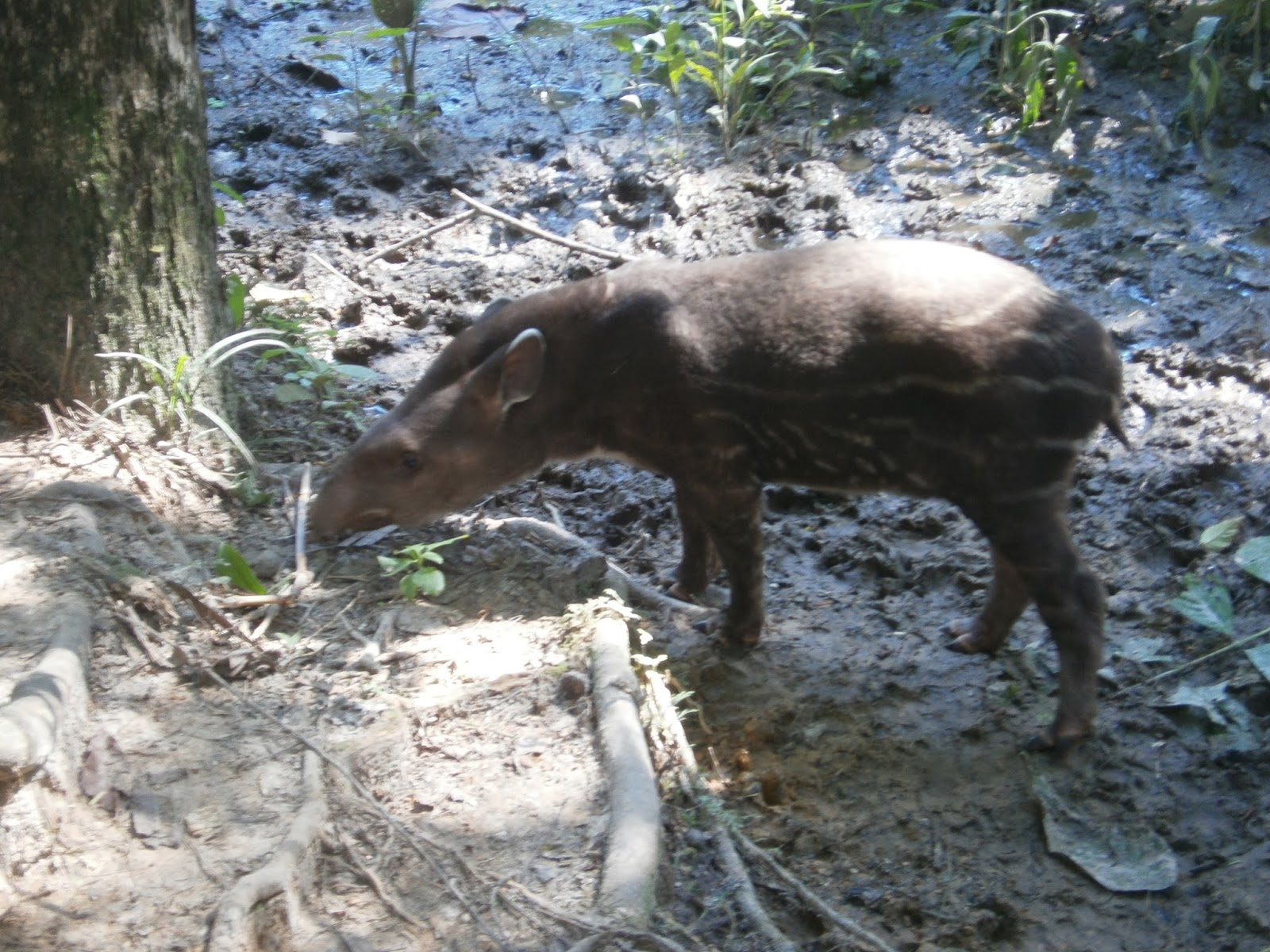
Our last outing was to visit the Butterfly Farm and animal rescue sanctuary, where animals that have been confiscated are brought to live.   We saw monkeys, macaws, toucans, an ocelot, a jaguar, a sloth and a tapir in the sanctuary.  It was incredible to see the animals up close that we had only caught far-away glimpses of in the jungle.  The tapir licked my hand and the ocelot tried to play with us through the fence.  It was adorable!
 

Finally our jungle adventure came to an end… and we hopped on a plane to Lima…where another adventure was waiting for us!